


Watch real stories, find tools, and connect with the community

Hear from real patients about their experiences taking BRINSUPRI
From the comfort of their favorite places, watch as real patients share their stories—from receiving a diagnosis to finding a path forward with BRINSUPRI.
Meet Jane
From one of her favorite places to catch a show, Jane shares her journey to a BE diagnosis, the challenge of unpredictable flares, and how she felt after she began treatment with BRINSUPRI.
Meet Barb
From the comfort of her garden, Barb shares her relief in finally receiving a BE diagnosis, the challenge of frequent flares, and how BRINSUPRI helped her find hope in managing her diagnosis.
Make the most out of your next doctor’s appointment with these resources
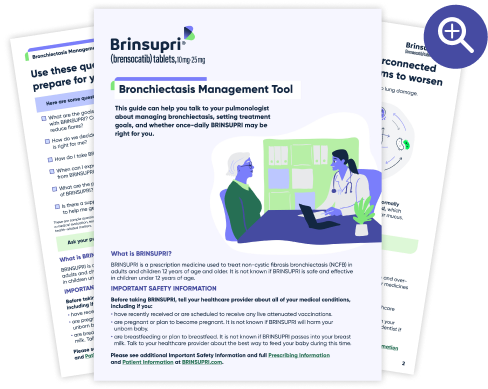
Bronchiectasis Management Tool
This guide can help you talk to your about managing BE setting treatment goals, and whether BRINSUPRI may be right for you.

BRINSUPRI educational brochure
This resource helps you learn more about BRINSUPRI, including how it works and what to expect as you start treatment.

Use these questions as a guide for your next doctor’s visit
What are the goals of treating with BRINSUPRI? Can it help reduce ?
How do we decide if BRINSUPRI is right for me?
How do I take BRINSUPRI?
When can I expect to see results from BRINSUPRI?
What are the potential side effects of BRINSUPRI?
Is there a support program available to help me get started on BRINSUPRI?

Find a pulmonologist
Some doctors see more patients with BE than others. That’s why it may be helpful to find a —such as a pulmonologist—or a BE health center that has experience with BE and prescribing medications like BRINSUPRI.
Use the links below to find a pulmonologist or BE center near you:

Connect with the bronchiectasis community
Want to connect with others, hear what the community is saying, or get involved in patient advocacy? Check out these BE support groups.
Bronchiectasis Info & Research has local support groups that hold regular meetings as well as online forums for patients, loved ones, physicians, and researchers.
Bronchiectasis and NTM Association helps address the unmet needs of the BE and nontuberculous mycobacterial (NTM) lung disease communities.
Learn more about airway clearance
Your pulmonologist may have recommended to help clear extra from your lungs. Explore the many different types available to you.
When you have bronchiectasis, or BE for short, your doctor or respiratory specialist may recommend airway clearance as part of your daily treatment plan.
Airway clearance refers to the removal of excess mucus from the lungs using techniques that help break up mucus, prevent it from building up, and allow it to be cleared more easily.
BE is a disease where your airways become permanently widened. This makes it more difficult to clear mucus, which can then begin to build up in your airways.
Too much mucus creates an attractive environment for bacteria, fungi and viruses.
Even with other medications, airway clearance is an important part of a BE management plan.
At times you may have “wet coughs.” Wet coughs can be a sign that you have too much mucus in your airways and need to clear it out.
Not clearing it out could make breathing more difficult and create an environment that can harbor an infection.
For some people, airway clearance feels time consuming and uncomfortable. That’s why it’s important to explore different techniques to find something that is manageable and productive for you. Let’s take a look at a few common methods.
There are several different methods of airway clearance that you may talk to your doctor or respiratory specialist about. Some involve specific types of coughing and others combine coughing with devices to help loosen excess mucus from the airways. Your doctor or respiratory specialist can help you explore the best options for you.
Let’s review a few common coughing techniques.
The first is called deep coughing. Deep coughing is a method that utilizes your breath and stomach muscles to help clear mucus from the lungs.
For some people, deep coughing might not always clear enough mucus. Your doctor may also recommend an alternative to deep coughing called huff coughing. Huff coughing relies on a series of rapid exhales to help loosen the mucus before coughing it out.
In addition to coughing, your doctor or respiratory specialist can show you how rhythmic, controlled breathing can help with relaxation.
They may also discuss devices that can help to thin and/or loosen mucus so that it’s easier to cough out.
Positive expiratory pressure devices, called PEP devices, have either a mask or a handheld mouthpiece. They help to loosen mucus by allowing air to flow in easily as you breathe in and offer resistance to air movement as you breathe out.
Some PEP devices have a mouthpiece that vibrates when you breathe out. These are called oscillating PEP devices.
This is a percussion vest. When worn, it vibrates against your chest to help loosen the mucus from your airway walls.
Another option for thinning mucus is a nebulizer containing hypertonic saline. A nebulizer is a machine that changes liquid medication into a mist that can be inhaled to treat lung conditions. By breathing in saline using a nebulizer, as prescribed by your doctor or respiratory specialist, you can add moisture to your lungs, which can loosen airway mucus for easier airway clearance.
Whether you are performing coughing techniques, using a device or a combination of different methods, maintaining an airway clearance routine as directed by your doctor or respiratory specialist is an important part of your BE treatment journey.
In order to stay on track with your airway clearance, you may find it helpful to create a daily routine.
Try to pair airway clearance with something you love to do, like reading, watching TV, or listening to a podcast.
Focus on setting a goal, and acknowledge yourself for taking an important step in proactively managing your condition.
And don’t stress—if you miss a session, just try to get back on track.
Regular airway clearance may help you control excess mucus when you are living with bronchiectasis.
Every person is unique, and it's important to find an airway clearance method that is right for you.
Your doctor or respiratory specialist can help you select a method and teach you the proper steps for performing it, so talk to your doctor or respiratory specialist about how you can fit airway clearance into your care plan.
Still have questions about bronchiectasis or BRINSUPRI?
See answers to some FAQs